About Egg Freezing
- What is the emotional cost of undergoing egg freezing now vs. taking chances with fertility later?
- How do I cope if I discover I’m infertile and cannot proceed with egg freezing?
- What are the emotional challenges involved in egg freezing and how do I prepare for them?
- Will I have sufficient funds to undergo fertilization and embryo transfer once I’m ready to do so?
- Do I have sufficient emotional support to undergo this process?
- How safe is this technology for my future child? For me?
- What are the legal implications of having eggs frozen if I’m married or in a relationship?
- What if something happens to me? What will happen with my eggs?
- How do I tell future partners about having frozen eggs? When do I tell them?
- How is egg freezing going to potentially affect what may happen in my current relationship? Am I prepared for the possibility that my current partner may not be supportive of egg freezing? What should I do about that?
- Read Dr. Aimee’s What You Need to Know About Egg Freezing article
- Predict the likelihood of live birth using the BWH Egg Freezing Calculator
- Watch Dr. Aimee’s IVF Class (The egg retrieval process for IVF is the same for egg freezing)
- Read Dr. Aimee’s What Happens When It’s Time for the Big Unfreeze article so you know what you need to consider when it’s time to use your eggs (if you need them)
- Read Dr. Aimee’s recommended book, The Fertility Experts’ Guide to Egg Freezing
- If you have a partner (or donor sperm) and plan to have children in the future, freezing embryos instead of eggs might be the right choice. Many patients start with Egg Freezing and then decide to create embryos mid-cycle. Learn more about it here.
As you plan for Egg Freezing, consider budgeting $18,000 plus medication, per cycle.
Preparing for Egg Freezing

What YOU’LL Do
Confirm Your Egg Freezing Calendar

Order Your Egg Freezing Medications
Ovarian Stimulation Medications
- Gonal-F
- Femara
- Menopur
- Follistim
GnRH Agonists and Antagonists
- Lupron
- Ganirelix
- Cetrotide
Trigger Shots
- Ovidrel
- Pregnyl and Novarel
- Lupron
Supportive Medications
- Omnitrope
Gather Your Fertility Essentials

Tell Us When Your Period Starts
What We’ll Do
Labs
- Infectious Diseases (ID): Tests for Hepatitis B surface antigen (HBsAg), Hepatitis C virus antibody (HCV Ab), Human Immunodeficiency Virus antibody (HIV Ab), Human T-lymphotropic virus antibody (HTLV), and Treponema antibody to identify any existing infections in both partners.
- Preconception Health: Tests for Thyroid-stimulating hormone (TSH), Vitamin D levels, Prolactin levels, Complete Blood Count (CBC), Rh factor, ABO blood type, Measles, Mumps, and Rubella titer (MMR titer), Varicella titer, and Antibody Screen to evaluate overall health and fertility in both partners.
- Ovarian Reserve and Hormonal Levels: Tests for Estradiol (E2), Progesterone (P4), Human Chorionic Gonadotropin (hCG), Anti-Müllerian Hormone (AMH), and Follicle-Stimulating Hormone (FSH) to assess ovarian function, ovarian reserve, and hormonal balance.
Genetic Testing
- Carrier Screening: Identifies genetic mutations that could be passed on to your baby, such as cystic fibrosis, spinal muscular atrophy, or fragile X syndrome. (learn more here)
- Chromosome Analysis: Detects chromosomal abnormalities such as translocations, inversions, or aneuploidies (e.g., Down syndrome). (learn more here)
BMI
- Optimal Response to Medications: Higher BMI may reduce the response to fertility medications, leading to fewer eggs retrieved or lower-quality embryos.
- Reduced Risk of Complications: Higher BMI is associated with increased risk of pregnancy complications, including gestational diabetes, hypertension, preeclampsia, and cesarean delivery.
- Impact on Ovarian Function: Obesity can affect hormonal balance and ovarian function.
- Risk of Ovarian Hyperstimulation Syndrome (OHSS): Higher BMI increases risk of developing OHSS, a complication of ovarian stimulation during Egg Freezing.
Treatment Day 1: Baseline Appointment

What to expect at your Baseline Appointment
- Ultrasound and Blood Work. Dr. Aimee will do an ultrasound to check for ovarian cysts and estimate the number of eggs she may retrieve. She’ll also do a blood draw.
- Egg Freezing Medication Calendar. Dr. Aimee will go over your Baseline Medication Calendar, outlining the meds, dosages, and instructions with you.
Sample Calendar:

- Injection Training. Our staff will show you how to mix your medication so you only need to give yourself one injection each night. Record this training with your phone for reference.
- Consent and Payment. You’ll sign your Egg Freezing lab order and consent forms to confirm your treatment plan. This is also when your first payment installment is due. Please check the due dates for your 2nd and 3rd installments. Here are our general Egg Freezing fees, but the invoices sent to you from our Financial Assistant will have the most accurate pricing.
What happens the evening after your appointment
- Take your meds between 6-8pm. This timing ensures that Dr. Aimee is immediately available if you need assistance!
- Your first day of injections typically takes the longest. Plan to spend an extra 30 minutes. Most patients will take medication for 8-14 days.
- It’s okay to use tampons, have sex, and enjoy light alcohol, coffee, and exercise. Just use common sense, and don’t worry — there isn’t anything you could eat or do that will affect your success.
Treatment Days 2-14
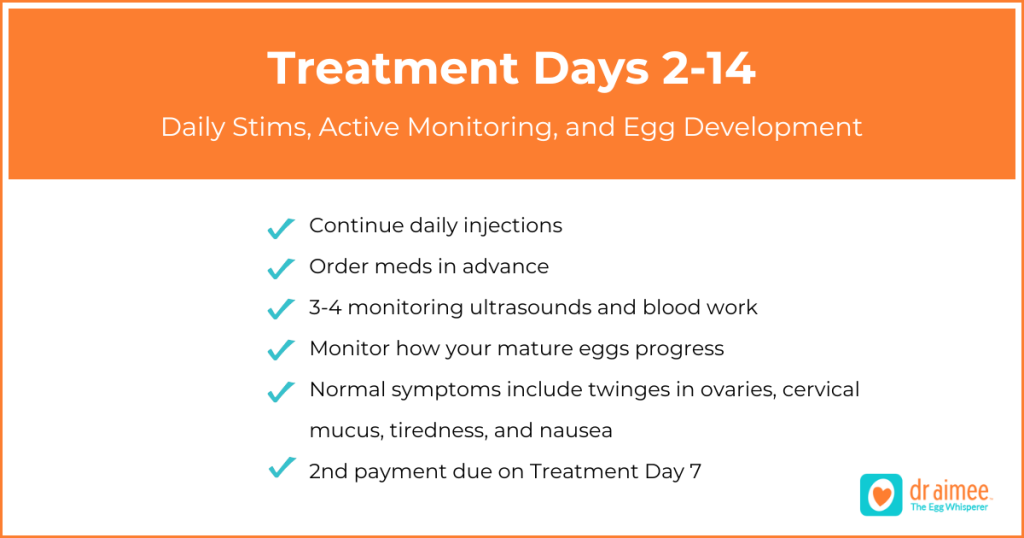
- Take your daily meds. Continue taking your injections daily as scheduled on your Medication Calendar.
- Go to 3-4 monitoring appointments. You’ll have Follicle Check appointments on Treatment Days 5, 7, 9, and possibly a few more visits as some cycles take a bit longer. Each visit will take no more than 15 minutes. At these appointments, Dr. Aimee will check your follicles’ growth and predict how many mature eggs you might have. She’ll do an ultrasound and blood draw to test your hormone levels. (Refer to our Sparkle Checklist to see what we’re checking during these appointments!) She’ll update your Medication Calendar based on how your body responds to the meds.
- Order your meds. You may need to order more meds. Make sure you have the meds you need for the next two nights.
- Potential symptoms. It’s normal to feel twinges in your ovaries or see egg white cervical mucus. You might also feel tired and nauseous — if so, ask for anti-nausea meds.
- Make payment. Your second installment is due on Treatment Day 7. Please make payment on time to avoid delays in your treatment plan.
Trigger Shot Day
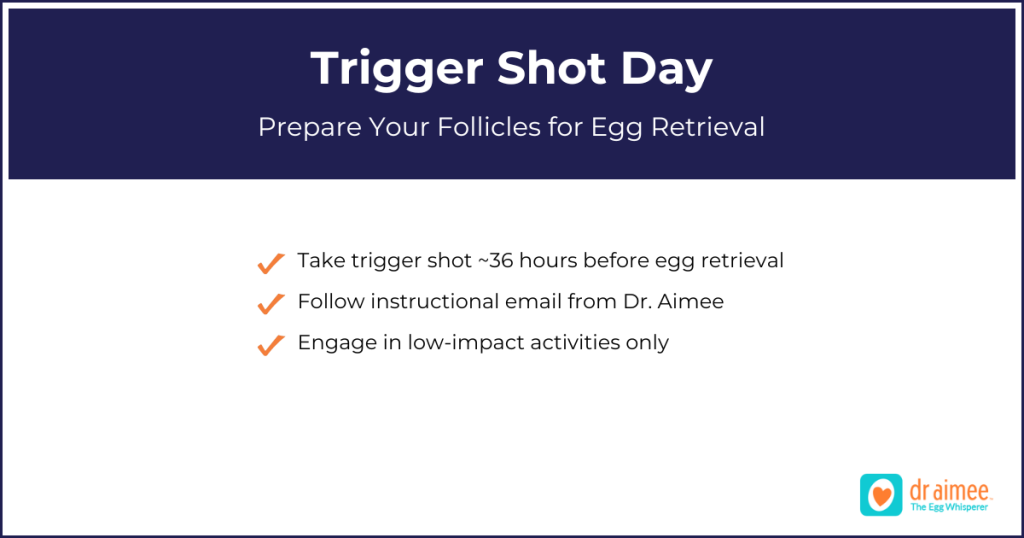
- Take trigger shot ~36 hours before retrieval. The Trigger Shot Day is crucial! It’s when we carefully time the trigger shot to prepare for your upcoming egg retrieval. This shot helps your eggs get ready for ovulation, so it’s crucial that it’s administered ~36 hours before the egg retrieval.
- Follow Dr. Aimee’s trigger instructions. Dr. Aimee will send you an Explainer Email with clear instructions on the trigger shot’s timing and dosage, along with how to prepare for the egg retrieval. She’s spent a lot of time reviewing your history to make sure that the plan is perfect for you!
- Engage in low-impact activities only. Light exercise is okay, just don’t overdo it.
Egg Retrieval Day
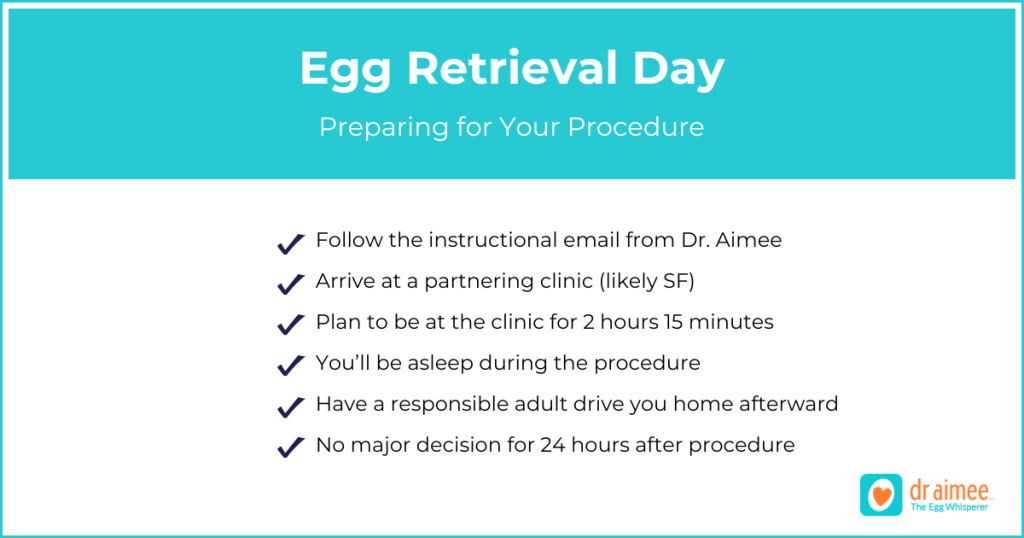
- Follow Dr. Aimee’s Explainer Email. To get ready for your egg retrieval, refer to Dr. Aimee’s detailed Explainer Email and follow her instructions closely. This is the day when Dr. Aimee will collect the eggs from your ovaries.
- BMI Protocol. If your BMI is over 30, you’ll take 1 Pepcid and 1 Reglan (aka Metoclopramide) with a tiny sip of water 3 hours before your procedure time.
- Meet Dr. Aimee at the Lab. This procedure takes place at The Egg Whisperer Lab in San Ramon, California. The email will give you all the details about the location, what to bring, and the timeline.
- Plan to be at the clinic for about 2 hours and 15 minutes. You must arrive at least 45 minutes before the procedure. Upon arrival, you’ll change into a gown and be connected to an IV. The Anesthesiologist will discuss the anesthesia process with you. Just before we proceed, you’ll empty your bladder. Take this opportunity to receive well wishes from your support person before we enter the procedure room.
- The procedure is about 30 minutes, during which you’ll be asleep. Using an elaborate system involving test tubes, suction lines, and a foot pedal, Dr. Aimee will perform the retrieval.
- After the procedure, you’ll be moved gently to a gurney and taken back to where you started for a smooth 45-minute rest and recovery.
- Before you leave, Dr. Aimee will let you know how many eggs were retrieved.
- Have a responsible driver. Due to the anesthesia, you must have a responsible adult drive you home and stay with you for the rest of the day.
- If you don’t have a companion and need a driver, we recommend Miriam Scott from SilverRide LLC. Contact her at (415) 861-7433.
- The clinic won’t let you leave unless you have a person you know with you. That person can be in the Uber with you but it can’t be an Uber driver.
- No major decision making. For the next 24 hours, avoid making major decisions, refrain from driving, consuming alcohol, operating machinery, or signing legal documents.
Day After Egg Retrieval
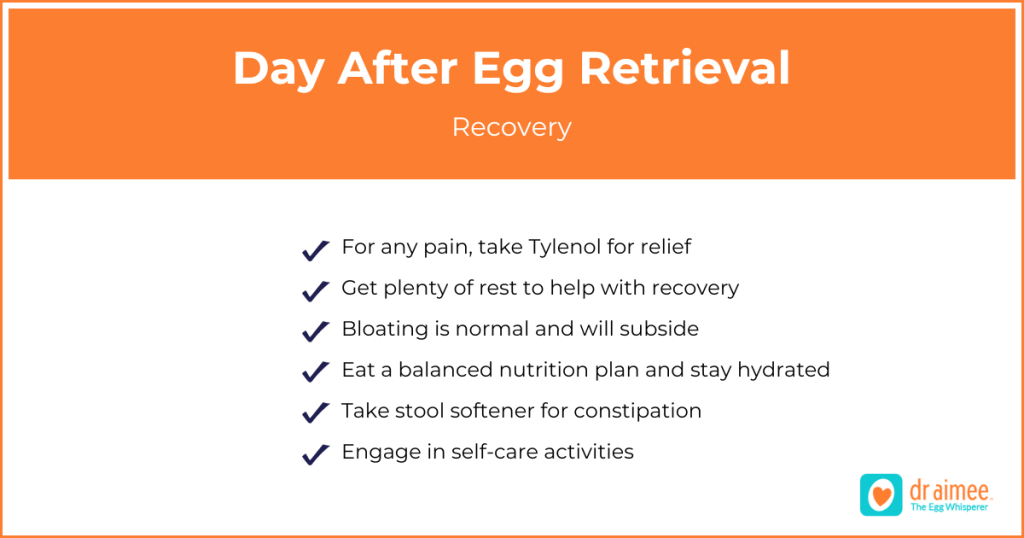
- Comfort Management. Here are some things to watch for and how to manage them:
- Pain Level: On a scale of 1-10, how’s your pain? You can take Tylenol for relief.
- Bloating: Rate your bloating from 1-10. It should go down over the next few days.
- IV Site: What does your IV site look like? Make sure it’s not infected.
- Nutrition: Are you eating well? Eating a balanced nutrition plan helps with recovery.
- Peeing: Is everything normal when you go to the bathroom? If not, let us know.
- Bowel Movements: If you’re constipated, consider using a stool softener like Colace.
- Spotting: Light spotting is common, but if you notice heavy bleeding or anything unusual, contact us.
Egg Thaw for Embryo Creation (Optional)
- Known Sperm Source: If you’re using a known sperm source (partner or donor), freezing embryos ensures you can use that specific sperm, which might not be available in the future.
- Embryo Viability: Embryos tend to survive the freezing and thawing process better than eggs, which may lead to higher pregnancy success rates.
- Tested Quality: Embryos can be cultured for several days to ensure they are developing properly before being frozen. This allows us to select the most viable ones.
- Preimplantation Genetic Testing (PGT): Embryos can be tested for genetic abnormalities before freezing, ensuring healthier embryos for future transfers and reducing the risk of genetic disorders.
- Immediate Use: Embryos can be used immediately if you decide to proceed with IVF later, avoiding the wait for fertilization.
- Avoids Future Procedures: Freezing embryos can eliminate the need for future egg retrievals, which can be physically and emotionally taxing.
- Fertility Preservation: For women undergoing treatments like chemotherapy or those with medical conditions affecting fertility, freezing embryos provides a more immediate option for future pregnancy.
- Age and Egg Quality: For women who are older or those concerned about egg quality, freezing embryos offers a clearer picture of the potential for successful pregnancy.
Egg Storage
Additional Resources
Fertility Essentials
Hotel
Acupuncture
East Bay
- Oakland – East Bay Fertility Wellness
- Oakland – East Bay Acupuncture w/ Aimee Ruiz
- Oakland – Integrative Wellness Center w/ Heidi Kao
- Piedmont – The Oldershaw Clinic
- Albany – Rizes Clinic w/ Dashal Moore
- Pleasant Hill – Earth & Air Wellness w/ Maria Ying
- Lafayette – Stillpoint Healing Arts w/ Dr. Mitsuko (Mimi)
San Francisco
SF Bay Area
- San Ramon, Orinda, San Francisco, San Mateo, San Jose – Nurture Acupuncture